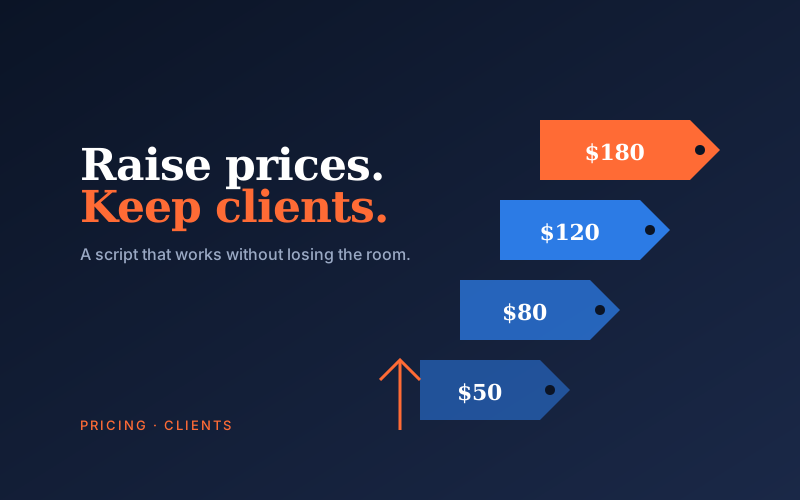
Raising prices on existing clients is one of those tasks that feels enormous in your head and turns out to be small in practice. Most clients say yes. A few negotiate. Almost nobody fires you. The terror is disproportionate to the actual stakes.
The cost of not raising prices
If you charged $80/hour three years ago and still charge $80/hour today, you have given yourself a real pay cut of roughly 12 to 18%, depending on inflation in your region. Meanwhile, your skills have improved, your portfolio has grown, and the clients you work with now are different from the ones you started with.
The cost of not raising prices is not just the money you do not collect. It is the unconscious resentment that builds when good clients feel like underpaying clients. That resentment leaks into your work eventually.
When to raise
- Annually, on a fixed date you choose (mine is January 1, communicated in November).
- When you finish a project and have a natural break before the next.
- When a client asks for an expansion of scope — do not just add hours at the old rate.
- When demand outstrips your capacity — if you are turning down work, your prices are too low.
The email script
The email is short on purpose. Long emails read defensive. Here is the structure that has worked for me:
Subject: Rate update for 2026
Hi [Name],
A quick heads-up: my rate is moving from [old] to [new] effective [date]. The new rate covers everything we currently work on together — no scope changes.
Happy to discuss if it raises any questions. Otherwise, the next invoice after [date] will reflect the change.
Thanks for the great work this year,
[Your name]
What this email does well: it states the change as a fact, not a request. It gives a date. It signals openness without inviting negotiation. It does not apologize. It does not justify with a list of reasons (that reads as defensive).
Handling pushback
About one in five clients will push back. The pushback comes in a few flavors:
- "That is a big jump" — confirm the percentage in your reply. If it is your first raise in three years, the annualized increase is much smaller. Frame it that way.
- "Our budget cannot support that" — offer to reduce scope at the new rate, not maintain scope at the old rate. Cutting scope is the only sustainable accommodation.
- "Can you grandfather us?" — for one cycle, yes. Indefinitely, no. Be specific about the end date.
- Silence — assume acceptance. Send the next invoice at the new rate.
The clients who push back hardest are usually the ones you were already underpriced for. The clients who say "of course, makes sense" are usually the ones you should have raised on a year earlier. Pay attention to who is in which group — it tells you a lot about which relationships are worth keeping.