Pricing is the highest-leverage decision you make as a SaaS founder. A 20% price increase on the same traffic, with no change to product or marketing, lands directly on the bottom line. A 20% price decrease has the opposite effect — and most indie founders are accidentally doing the second one.
The anchor problem
Every visitor arrives with a price in mind, whether they know it or not. The anchor is set before they see your product — by competitors, by the tools they replaced, by the cost of doing nothing. Your job is not to fight the anchor; it is to choose which anchor they bring with them.
Compare yourself to the expensive incumbent and your $29/month feels like a steal. Compare yourself to a free tool and the same $29 feels outrageous. The comparison set you put on your landing page is the anchor.
Three-tier framing
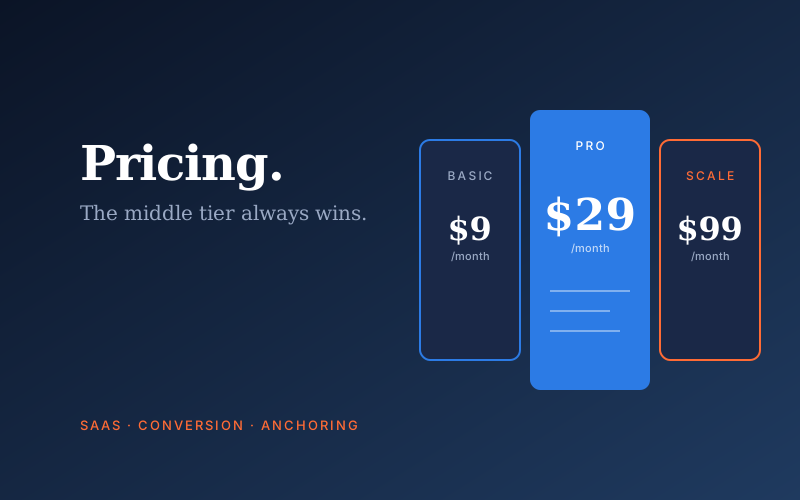
Three pricing tiers consistently outperform two or four. The reason is structural:
- The cheapest tier sets the floor and brings in price-sensitive users.
- The middle tier is what you actually want most users to choose.
- The expensive tier makes the middle tier look reasonable by comparison.
The expensive tier is rarely the most profitable in absolute terms. Its job is to make the middle tier sell. Strip it out and the middle tier loses 15 to 25% of its conversion rate.
Annual vs monthly: the trap
Most indie founders default to "20% off if you pay annually" because that is what everyone else does. This leaves money on the table.
Annual discounts should be priced like options, not like generosity. A standard 16 to 17% discount (two months free) is plenty for most products and significantly improves cash flow. Discounts above 30% signal weakness and condition users to wait for sales.
Pricing experiments worth running
- Round-up test — try $19 vs $20, $49 vs $50. Conversion is usually identical, revenue per visitor goes up.
- Anchor swap — change the comparison set on your pricing page. Watch conversion shift.
- Tier rename — "Pro" performs differently than "Business" or "Studio." Names imply audience.
- Sticker shock removal — show monthly price by default, even on annual-discounted plans. The big number is the friction.
Run one experiment at a time. Pricing tests need at least a few hundred conversions to draw real conclusions, which means most indie products will run each test for several weeks. Do not stack changes — you will not know which one moved the needle.