The single biggest financial mistake freelancers make is treating gross revenue as if it were income. It is not. A meaningful chunk of every dollar that hits your account already belongs to the government — you are just holding it temporarily.
The standard tax-trap pattern
Year one, you make $80,000 freelancing. You pay yourself like an employee, mentally treating it as $80,000 of income. April arrives, you owe $22,000 in tax, and you have $4,000 in savings. The pattern repeats with smaller numbers and bigger panic until something gives.
Every freelancer goes through some version of this once. The point of a tax-set-aside system is to make sure it only happens once.
The 30/30/30/10 split
The simplest mental model that actually works:
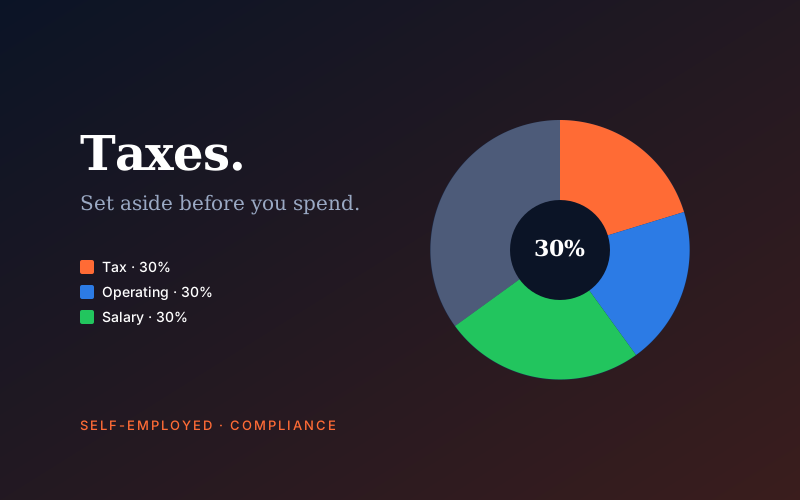
- 30% to the tax account — untouchable until your tax bill arrives.
- 30% to operating expenses — software, contractors, ads, the unsexy costs of running the business.
- 30% to your salary — what hits your personal account each month.
- 10% to a profit / buffer account — quarterly bonus to yourself, or runway extension.
The beauty of the split is that it adjusts automatically when revenue changes. A bad month means a smaller salary, but it also means a smaller tax bill. You stay solvent.
Automating the split
The system only works if it is automatic. Manual transfers are skipped exactly when you most need them — when revenue is high and you feel rich.
- Open four accounts (most fintech business banks let you create sub-accounts at no cost).
- Label them:
Tax,Operations,Salary,Buffer. - On the same day each month, transfer the percentages from the main receiving account.
- Schedule a recurring transfer from
Salaryto your personal account.
When to recalibrate
Recalibrate after every tax year, not before. The split that worked at $60k of revenue may be too conservative at $200k, and too aggressive if you took a sabbatical mid-year.
Look at last year's effective tax rate. If you set aside 30% and only owed 22%, your buffer grew — keep the split, enjoy the cushion. If you set aside 30% and owed 34%, raise the tax allocation to 35% next year and stop pretending taxes are a surprise.